
Gian Marco Ludovici, Paola Amelia Tassi, Alba Iannotti, Colomba Russo, Fausto D’Agostino, Matilde Neble Segade, Timothy Alexander Mousseau, Andrea Malizia.
We are proud to announce the publication of the open-access paper:
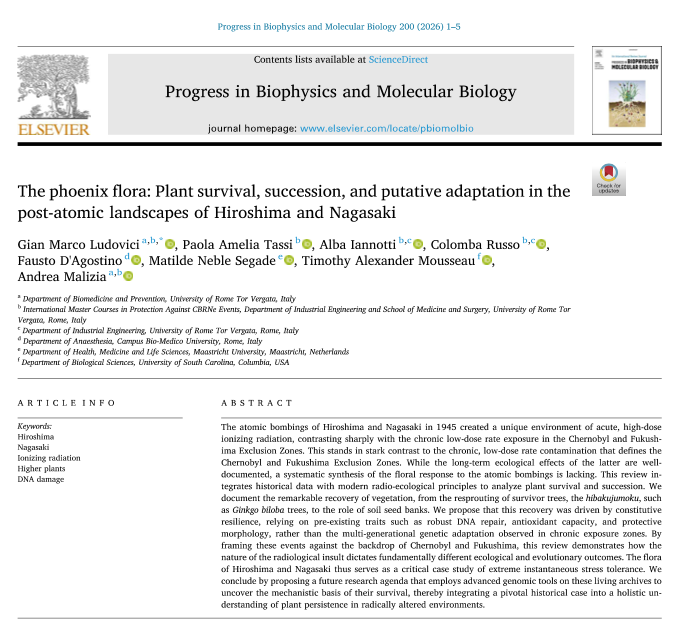
“The phoenix flora: Plant survival, succession, and putative adaptation in the post-atomic landscapes of Hiroshima and Nagasaki” (DOI: https://doi.org/10.1016/j.pbiomolbio.2026.02.004), now available in Progress in Biophysics and Molecular Biology and freely downloadable at:
https://www.sciencedirect.com/science/article/pii/S007961072600009X
This landmark study represents the first comprehensive synthesis of plant survival and ecological succession following the acute, high-dose ionizing radiation exposure caused by the atomic bombings of Hiroshima and Nagasaki in 1945. The work offers a rigorous comparison with the chronic low-dose exposure environments of the Chernobyl Exclusion Zone and the Fukushima Exclusion Zone, highlighting how fundamentally different exposure profiles shape ecological and evolutionary outcomes.
Integrating historical documentation with modern radio-ecological and molecular principles, the authors document the extraordinary recovery of vegetation, including the resprouting of the hibakujumoku—survivor trees such as Ginkgo biloba—and the key contribution of soil seed banks.
A central scientific advancement of the paper is the proposal of the innovative “constitutive resilience” model, suggesting that plant survival in the acute radiation environment relied primarily on pre-existing biological traits—efficient DNA repair systems, antioxidant capacity, and protective morphology—rather than on multi-generational genetic adaptation typical of chronically contaminated areas.
Particularly outstanding is the scientific leadership of Dr. Gian Marco Ludovici, whose intellectual vision and interdisciplinary rigor have driven the development of a novel theoretical framework with strong implications for radiation ecology, environmental risk assessment, and CBRNe science.
His contribution, together with the entire research team, elevates this historical case into a forward-looking research platform and proposes the application of advanced omics technologies to these living biological archives in order to uncover the mechanistic basis of survival and resilience.
This publication represents a significant contribution to the international scientific community and stands as a powerful testament to the capacity of life to regenerate even under extreme radiological stress.
Write a comment