
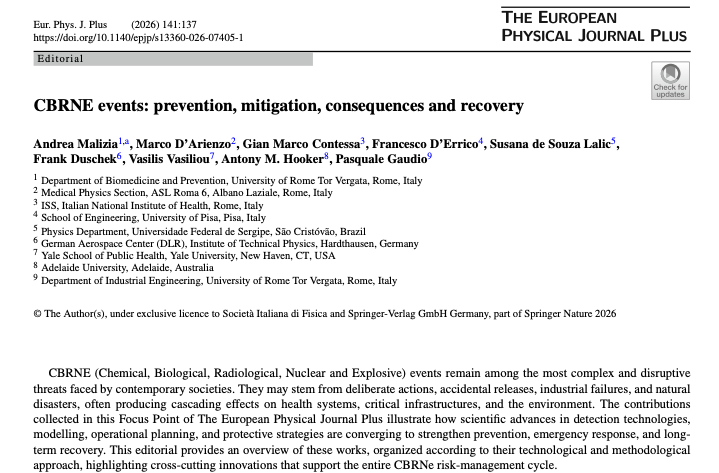
We are proud to announce that the Editorial of the Focus Point “CBRNE events: prevention, mitigation, consequences and recovery” has been officially published in The European Physical Journal Plus (EPJ Plus) and is now available online.
Editorial Reference
Malizia A., D’Arienzo M., Contessa G.M., D’Errico F., de Souza Lalic S., Duschek F., Vasiliou V., Hooker A.M., Gaudio P. (2026).
CBRNE events: prevention, mitigation, consequences and recovery.
The European Physical Journal Plus.
© The Author(s), under exclusive licence to Società Italiana di Fisica and Springer-Verlag GmbH Germany, part of Springer Nature 2026.
🔗 Full article available at:
https://link.springer.com/article/10.1140/epjp/s13360-026-07405-1
⸻
A Strategic Scientific Achievement
CBRNE (Chemical, Biological, Radiological, Nuclear and Explosive) events remain among the most complex and disruptive threats faced by contemporary societies. They may arise from deliberate attacks, accidental releases, industrial failures, or natural disasters, often triggering cascading consequences on healthcare systems, critical infrastructures, environmental matrices, and socio-economic stability.
This Focus Point represents a structured and interdisciplinary effort to address the entire CBRNe risk-management cycle:
• Prevention and early detection
• Operational mitigation strategies
• Consequence management
• Recovery and resilience-building
The editorial provides a comprehensive overview of the contributions collected within this special section, highlighting how advances in:
• Detection technologies
• Radiation and chemical sensing
• Predictive modelling
• Decision-support systems
• Operational planning
• Protective engineering strategies
are progressively converging toward integrated, science-based risk governance frameworks.
The contributions span multiple technological and methodological approaches, reinforcing the essential role of radiation physics and broader CBRNe science as complementary pillars of modern safety and security architectures.
⸻
An International and Interdisciplinary Editorial Board
The Editorial has been coordinated by an international team of experts from leading institutions:
• University of Rome Tor Vergata (Italy)
• Italian National Institute of Health – ISS (Italy)
• University of Pisa (Italy)
• ASL Roma 6 (Italy)
• Universidade Federal de Sergipe (Brazil)
• German Aerospace Center – DLR (Germany)
• Yale University School of Public Health (USA)
• Adelaide University (Australia)
This broad institutional representation reflects the global dimension of CBRNe challenges and the necessity of transnational scientific cooperation.
⸻
Completion of the Scientific Path Linked to SICC Series CBRNe Conference 2023
With the publication of this Editorial and the full Focus Point, we officially conclude the scientific work initiated during the SICC Series CBRNe Conference 2023. The research discussions, technical sessions, and scientific exchanges that characterized the conference have now been consolidated into a peer-reviewed, indexed, and internationally accessible scientific output.
This marks a significant milestone for the CBRNe scientific community and further strengthens the academic and operational bridge between research institutions, defence stakeholders, civil protection authorities, and international partners.
⸻
Call for Abstracts – SICC Series CBRNe Conference 2026
The scientific journey continues.
The Call for Abstracts for the SICC Series CBRNe Conference 2026 is now open.
Researchers, practitioners, decision-makers, engineers, medical physicists, and experts working across the CBRNe spectrum are invited to submit their contributions.
🔗 Abstract submission portal:
https://www.sicc-series.com/abstract-submission-1/
The 2026 edition aims to further expand the dialogue between academia, operational communities, policy-makers, and industry, fostering innovation across prevention, detection, modelling, emergency response, and recovery strategies.
⸻
From Research to Operational Impact
The publication of this Focus Point demonstrates how structured scientific collaboration can directly support:
• Evidence-based decision-making
• Technological readiness enhancement
• Improved emergency preparedness
• International cooperation frameworks
In an era characterized by hybrid threats and rapidly evolving risk scenarios, sustained investment in scientific excellence remains the cornerstone of resilient societies.
We invite the international CBRNe community to read the Editorial, explore the full collection of articles, and actively contribute to the next chapter at SICC Series CBRNe Conference 2026.
The work continues — stronger, broader, and more integrated than ever.
Write a comment