
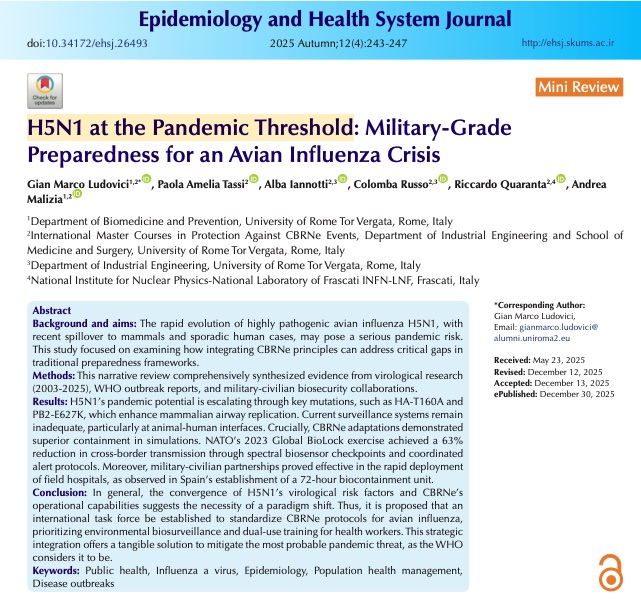
A new mini review entitled “H5N1 at the Pandemic Threshold: Military-Grade Preparedness for an Avian Influenza Crisis” has been published in Epidemiology and Health System Journal (2025;12(4):243–247).
🔗 Full Open Access Article:
https://ehsj.skums.ac.ir/Article/ehsj-26493
Authors:
Gian Marco Ludovici, Paola Amelia Tassi, Alba Iannotti, Colomba Russo, Riccardo Quaranta, Andrea Malizia
Affiliations:
Department of Biomedicine and Prevention – University of Rome Tor Vergata
International Master Courses in Protection Against CBRNe Events – University of Rome Tor Vergata
Department of Industrial Engineering – University of Rome Tor Vergata
INFN – National Laboratory of Frascati
A Strategic Scientific Contribution to Global Health Security
The mini review explores the escalating pandemic risk posed by highly pathogenic avian influenza H5N1, particularly in light of recent mammalian spillover events and key adaptive mutations such as HA-T160A and PB2-E627K, which enhance replication in mammalian airways.
The authors systematically analyze:
• Virological evolution (2003–2025)
• WHO outbreak reports
• Animal-human interface vulnerabilities
• Military-civilian biosecurity collaborations
• NATO CBRNe simulation exercises
Notably, NATO’s Global BioLock exercise (2023) demonstrated a 63% reduction in simulated cross-border transmission through coordinated biosensor checkpoints and alert protocols. The review further discusses rapid 72-hour biocontainment deployment models and scalable biosurveillance solutions.
A CBRNe Paradigm Shift
The study proposes the establishment of an international task force to standardize CBRNe protocols for avian influenza preparedness, integrating:
• Environmental biosurveillance
• Dual-use training for health professionals
• Quantitative modeling (e.g., Spatiotemporal Epidemiological Modeler – STEM)
• Military-grade early warning systems
The work represents a strategic convergence between global health and security paradigms.
Acknowledgments
Special thanks to Dr. Gian Marco Ludovici, Principal Investigator of this work, for his outstanding leadership and vision.
We also sincerely thank all co-authors:
Paola Amelia Tassi
Alba Iannotti
Colomba Russo
Riccardo Quaranta
Andrea Malizia
This publication further strengthens the scientific mission of the International Master Courses in Protection Against CBRNe Events at the University of Rome Tor Vergata.
Write a comment