
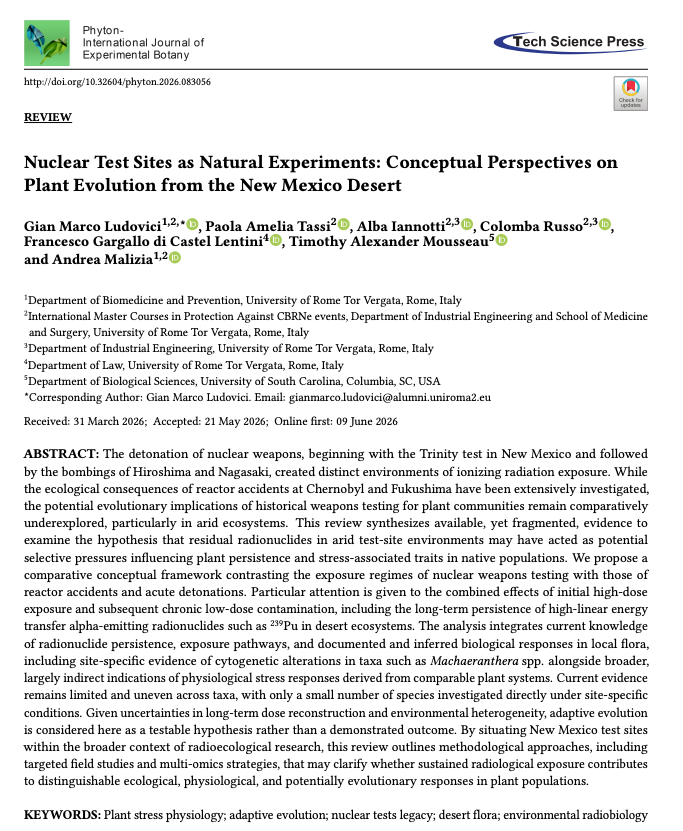
The International Master Courses in Protection against CBRNe Events of the University of Rome Tor Vergata are pleased to announce the publication of a new scientific review entitled
The study was authored by Gian Marco Ludovici, Paola Amelia Tassi, Alba Iannotti, Colomba Russo, Francesco Gargallo di Castel Lentini, Timothy Alexander Mousseau, and Andrea Malizia, bringing together expertise from environmental radiobiology, ecology, CBRNe sciences, law, and evolutionary biology.
The paper investigates one of the most intriguing and still insufficiently explored questions in environmental radiobiology: whether historical nuclear weapons testing sites can act as natural laboratories for studying long-term ecological and evolutionary responses to ionizing radiation.
Starting from the legacy of the Trinity Test in New Mexico—the first nuclear detonation in history—the authors examine how decades of residual contamination, particularly from long-lived radionuclides such as plutonium-239, may have influenced plant communities inhabiting arid desert ecosystems.
The review proposes a novel conceptual framework comparing exposure scenarios associated with:
- Nuclear weapons testing;
- Nuclear reactor accidents such as Chernobyl and Fukushima;
- Acute wartime detonations.
Special attention is dedicated to the interaction between initial high-dose radiation exposure and prolonged low-dose environmental contamination. The authors discuss available evidence concerning cytogenetic alterations, physiological stress responses, and potential adaptive mechanisms observed in desert plant species exposed to radiological contamination.
Importantly, the article emphasizes that adaptive evolution remains a scientific hypothesis requiring further investigation rather than a demonstrated outcome. To address this challenge, the authors propose future multidisciplinary research integrating:
- Field radioecology;
- Environmental dosimetry;
- Genomics and transcriptomics;
- Multi-omics approaches;
- Long-term ecological monitoring.
The publication contributes to the growing scientific discussion on the environmental consequences of radiological contamination and highlights how historical nuclear test sites may provide unique opportunities for understanding biological resilience under chronic radiation exposure.
A special acknowledgment goes to Dr. Gian Marco Ludovici, Principal Investigator and corresponding author of the study, for leading this innovative research effort. Congratulations are also extended to Paola Amelia Tassi, Alba Iannotti, Colomba Russo, Francesco Gargallo di Castel Lentini, Prof. Timothy Alexander Mousseau, internationally recognized expert in radiation ecology, and Prof. Andrea Malizia for their valuable contributions.
The full publication is available at:
Write a comment