
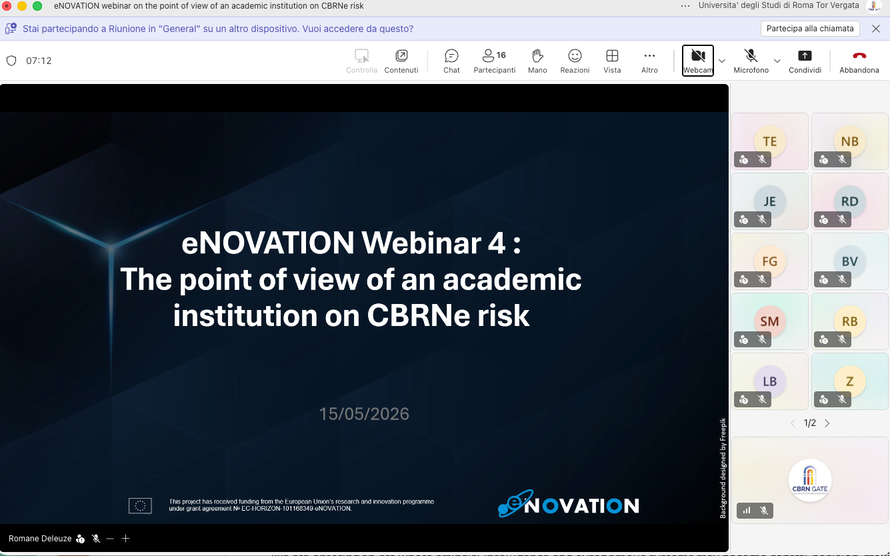
On 16 June 2026, the University of Rome Tor Vergata contributed to the eNOVATION Webinar Series, presenting an academic perspective on current and emerging challenges in Chemical, Biological, Radiological, Nuclear and explosive (CBRNe) risk management.
The webinar, entitled “CBRNe Risk – The Point of View of an Academic Institution”, brought together multidisciplinary expertise to discuss how universities can contribute to preparedness, resilience, education, and innovation in the face of increasingly complex security threats.
The first presentation, “RN Emergencies: From Artificial Intelligence to Hybrid War – A Link Between Old and New Threats”, was delivered by Prof. Andrea Malizia, Associate Professor in Nuclear Measurements and Instrumentation at the University of Rome Tor Vergata and Director of the International Master Courses in Protection Against CBRNe Events. The lecture explored the evolution of radiological and nuclear emergencies, highlighting how traditional RN threats are now intertwined with emerging challenges such as artificial intelligence, hybrid warfare, autonomous systems, misinformation, and the protection of critical infrastructures. The presentation emphasized the importance of integrating technological innovation, advanced decision-support tools, and interdisciplinary education into modern CBRNe preparedness strategies.
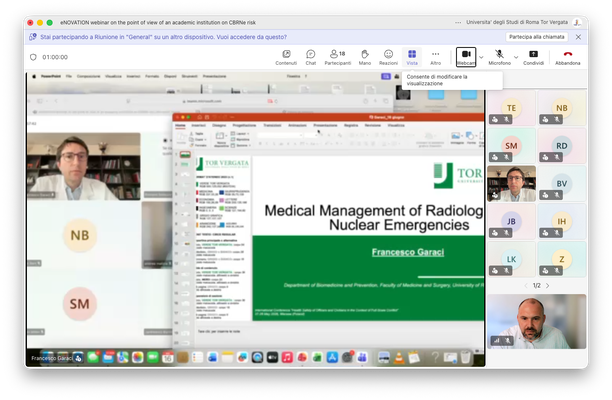
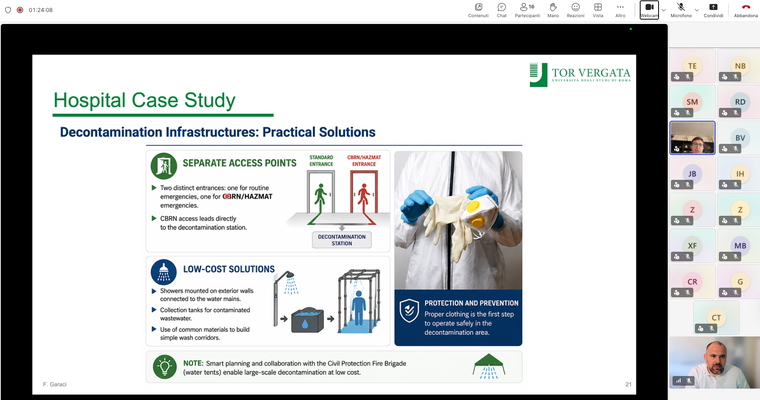
The second presentation, “The Experience of the Operative Complex Unit During the COVID-19 Emergency: How Our Daily Work Changed During This Non-Conventional Emergency”, was delivered by Prof. Francesco Garaci, Full Professor and Dean of the Section of Diagnostics at the Faculty of Medicine and Surgery of the University of Rome Tor Vergata, and Director of the Operative Complex Units of Diagnostic and Nuclear Medicine at Policlinico Tor Vergata. Drawing on first-hand experience gained during the COVID-19 pandemic, Prof. Garaci illustrated how healthcare systems rapidly adapted to an unprecedented biological emergency, sharing valuable lessons on hospital organization, diagnostic pathways, operational continuity, multidisciplinary coordination, and preparedness for future large-scale health crises.
The webinar demonstrated the crucial role that academia plays in bridging scientific research, higher education, healthcare, and operational practice. By combining expertise in radiological and nuclear risk management with real-world experience from the COVID-19 emergency, the event provided participants with a comprehensive overview of the challenges posed by non-conventional threats and the importance of developing resilient systems capable of responding effectively to future crises.
The participation of the University of Rome Tor Vergata in the eNOVATION Webinar Series further reinforces its commitment to promoting international collaboration, knowledge sharing, and capacity building in the field of CBRNe risk reduction and emergency preparedness. Through initiatives such as the International Master Courses in Protection Against CBRNe Events and its active involvement in European research projects, the University continues to contribute to the development of innovative approaches for strengthening societal resilience against evolving security challenges.
Write a comment