
The CBRNe scientific community continues to advance innovative solutions for radiation protection through international collaboration.
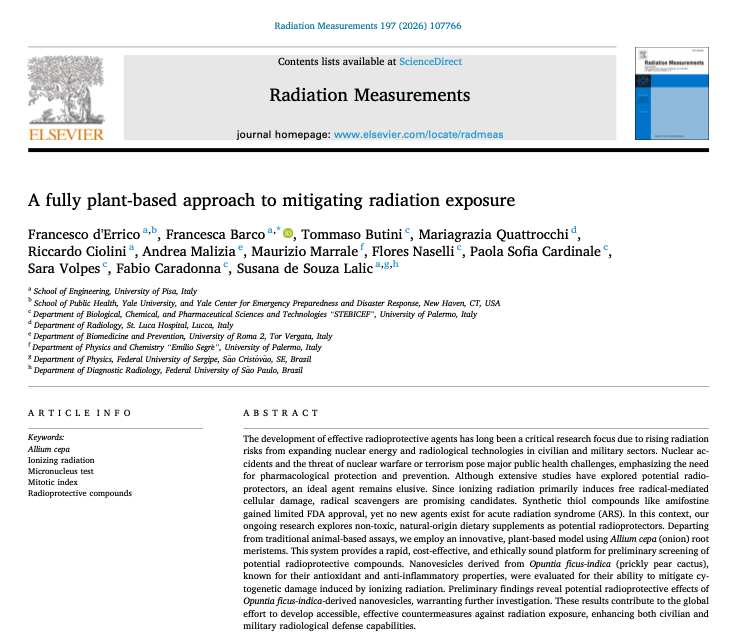
A new paper entitled “A Fully Plant-Based Approach to Mitigating Radiation Exposure” has been published in Radiation Physics and Chemistry, presenting an innovative and sustainable approach to the development of future radioprotective countermeasures.
The publication is available at:
https://www.sciencedirect.com/science/article/pii/S1350448726001630
The study was carried out by an international multidisciplinary team composed of:
- Francesco d’Errico – School of Engineering, University of Pisa, Italy; School of Public Health, Yale University & Yale Center for Emergency Preparedness and Disaster Response, USA
- Francesca Barco – School of Engineering, University of Pisa, Italy
- Tommaso Butini – Department of Biological, Chemical and Pharmaceutical Sciences and Technologies (STEBICEF), University of Palermo, Italy
- Mariagrazia Quattrocchi – Department of Radiology, St. Luca Hospital, Lucca, Italy
- Riccardo Ciolini – School of Engineering, University of Pisa, Italy
- Andrea Malizia – Department of Biomedicine and Prevention, University of Rome Tor Vergata, Italy
- Maurizio Marrale – Department of Physics and Chemistry “Emilio Segrè”, University of Palermo, Italy
- Flores Naselli – Department of Biological, Chemical and Pharmaceutical Sciences and Technologies (STEBICEF), University of Palermo, Italy
- Paola Sofia Cardinale – Department of Biological, Chemical and Pharmaceutical Sciences and Technologies (STEBICEF), University of Palermo, Italy
- Sara Volpe – Department of Biological, Chemical and Pharmaceutical Sciences and Technologies (STEBICEF), University of Palermo, Italy
- Fabio Caradonna – Department of Biological, Chemical and Pharmaceutical Sciences and Technologies (STEBICEF), University of Palermo, Italy
- Susana de Souza Lalic – School of Engineering, University of Pisa, Italy; Department of Physics, Federal University of Sergipe, Brazil; Department of Diagnostic Radiology, Federal University of São Paulo, Brazil.
The research proposes an innovative plant-based experimental model using Allium cepa root meristems to evaluate natural radioprotective compounds, replacing traditional preliminary animal-based screening methods.
The study investigated nanovesicles derived from Opuntia ficus-indica, demonstrating promising antioxidant and radioprotective effects against ionizing radiation-induced cellular damage. These encouraging results pave the way for future research aimed at developing safe, effective and sustainable countermeasures for both civilian and military radiological emergencies.
A special acknowledgement goes to Professor Francesco d’Errico, Principal Investigator of this research activity, whose scientific leadership made this international collaboration possible, and to the University of Pisa for coordinating this important multidisciplinary project.
Congratulations to all the authors for this significant scientific achievement.
Write a comment