
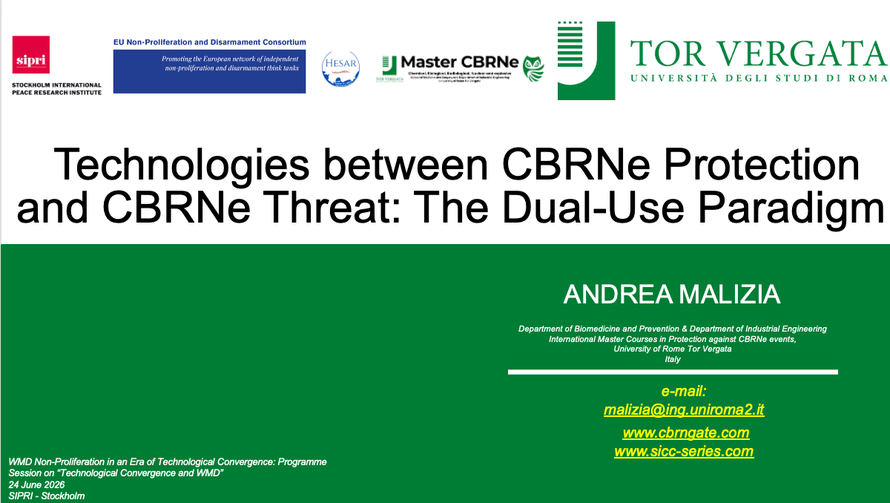
On the morning of 24 June 2026, Prof. Andrea Malizia, Associate Professor in Nuclear Measurements and Instrumentation at the University of Rome Tor Vergata and Director of the International Master Courses in Protection Against CBRNe Events, was invited to deliver the lecture "Technologies between CBRNe Protection and CBRNe Threat: The Dual-Use Paradigm" during the international course "Weapons of Mass Destruction (WMD) Non-Proliferation and Disarmament in an Era of Technological Convergence."
The course, jointly organized by the Stockholm International Peace Research Institute (SIPRI) and the EU Non-Proliferation and Disarmament Consortium (EUNPDC), took place in Stockholm, Sweden, from 23 to 25 June 2026. Bringing together graduate students and early-career professionals from technical and scientific disciplines, the programme explored the challenges that emerging technologies pose to international security, arms control, non-proliferation, and disarmament.
During his lecture, Prof. Malizia examined one of the defining issues of contemporary CBRNe security: the dual-use nature of emerging technologies. The presentation analysed how innovations such as artificial intelligence, robotics, autonomous systems, advanced sensors, digital decision-support platforms, and big data analytics are transforming both protection capabilities and threat scenarios. While these technologies significantly improve preparedness, detection, monitoring, and emergency response, they may also be exploited for malicious purposes, creating new vulnerabilities for governments and international organizations.
The lecture highlighted the growing need for multidisciplinary governance capable of balancing scientific innovation with security requirements, emphasizing that future non-proliferation policies must increasingly consider the rapid convergence of civilian and military technologies.
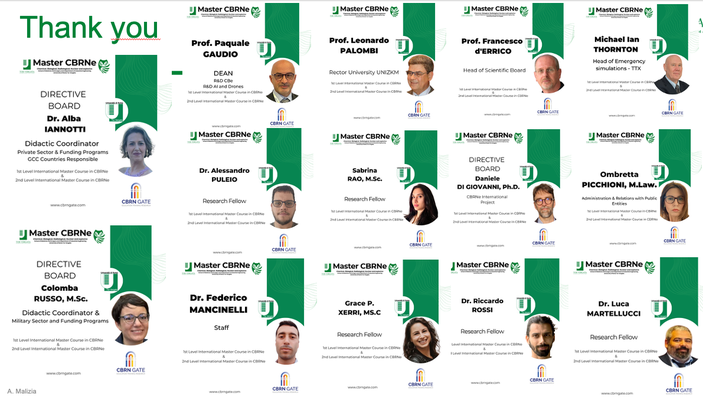
To reinforce the educational objectives of the course, Prof. Andrea Malizia, together with Dr. Alba Iannotti and Dr. Colomba Russo from the University of Rome Tor Vergata, designed and delivered a dedicated Tabletop Exercise (TTX) specifically developed for the participants.
The interactive exercise challenged students to address a realistic scenario involving emerging dual-use technologies and a complex CBRNe crisis. Working in multidisciplinary international teams, participants analysed technical information, assessed risks, evaluated governance and non-proliferation implications, identified possible response options, and developed coordinated strategies to manage the evolving scenario. The exercise stimulated critical thinking, collaborative problem-solving, and evidence-based decision-making while allowing participants to immediately apply the concepts discussed during the lecture.
The integration of an advanced scientific lecture with a bespoke practical exercise reflected the educational philosophy of the International Master Courses in Protection Against CBRNe Events at the University of Rome Tor Vergata, where theoretical knowledge is systematically combined with realistic operational simulations to prepare future experts for complex international security challenges.
Throughout the three-day programme, the SIPRI–EUNPDC course addressed key topics including the foundations of WMD non-proliferation and disarmament, international arms control regimes, export control systems, governance of emerging technologies, and the adaptation of international security frameworks to an increasingly fragmented geopolitical environment characterized by interstate conflicts, technological convergence, and the erosion of traditional arms control mechanisms.
Prof. Malizia's participation as an invited lecturer represents another important international recognition of the expertise developed at the University of Rome Tor Vergata in the fields of CBRNe risk assessment, dual-use technologies, emergency preparedness, and international security. It also highlights the growing contribution of the International Master Courses in Protection Against CBRNe Events to international education and capacity building, promoting innovative teaching methodologies that combine scientific excellence with practical, scenario-based learning.
The contribution of the University of Rome Tor Vergata to this prestigious international initiative further strengthens its long-standing collaboration with leading organizations engaged in global non-proliferation, arms control, and CBRNe security, reaffirming its commitment to educating the next generation of scientists, policymakers, and security professionals capable of addressing the rapidly evolving challenges posed by emerging technologies.
Write a comment