
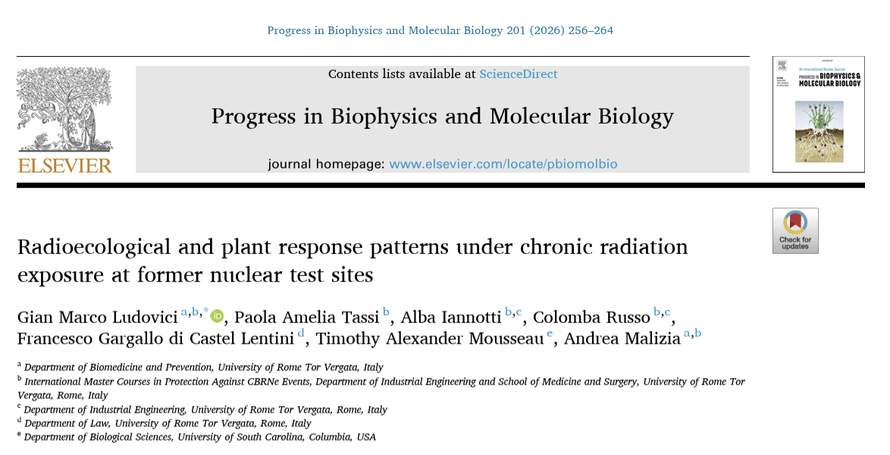
The International Master Courses in Protection Against CBRNe Events and the University of Rome Tor Vergata are pleased to announce the publication of a new peer-reviewed scientific article in the prestigious journal Progress in Biophysics and Molecular Biology.
"Radioecological and plant response patterns under chronic radiation exposure at former nuclear test sites" has been published as an Open Access article, making it freely available to researchers, professionals, and policymakers worldwide.
The publication is led by Dr. Gian Marco Ludovici, Principal Investigator (PI), whose work provides a comprehensive review of the long-term environmental and biological consequences of chronic radiation exposure at some of the world's most historically significant nuclear weapons testing areas.
Authors and Affiliations
- Dr. Gian Marco Ludovici – Department of Biomedicine and Prevention, University of Rome Tor Vergata, Italy; International Master Courses in Protection Against CBRNe Events, University of Rome Tor Vergata
- Dr. Paola Amelia Tassi – International Master Courses in Protection Against CBRNe Events, University of Rome Tor Vergata
- Dr. Alba Iannotti – International Master Courses in Protection Against CBRNe Events; Department of Industrial Engineering, University of Rome Tor Vergata
- Dr. Colomba Russo – International Master Courses in Protection Against CBRNe Events; Department of Industrial Engineering, University of Rome Tor Vergata
- Prof. Francesco Gargallo di Castel Lentini – Department of Law, University of Rome Tor Vergata
- Prof. Timothy Alexander Mousseau – Department of Biological Sciences, University of South Carolina, Columbia, USA
- Prof. Andrea Malizia – Department of Biomedicine and Prevention, University of Rome Tor Vergata; International Master Courses in Protection Against CBRNe Events
About the Study
The review examines the radioecological legacy of former nuclear weapons testing sites, including:
- Nevada Test Site (USA)
- Semipalatinsk Test Site (Kazakhstan)
- Marshall Islands
- French Polynesia
The authors analyse decades of environmental monitoring and radioecological research to investigate radionuclide persistence, environmental transfer pathways, and plant and ecosystem responses under chronic radiation exposure.
The study highlights that radionuclides such as Cesium-137, Strontium-90, plutonium isotopes, americium, and tritium continue to contribute to heterogeneous contamination patterns many decades after nuclear testing ceased. While chronic radiation exposure is associated with measurable physiological and ecological responses in plants and other organisms, the evidence for consistent long-term ecosystem adaptation remains limited and highly dependent on local environmental conditions.
The authors conclude that former nuclear test sites continue to represent invaluable natural laboratories for advancing radioecology, environmental monitoring, radiation protection, and long-term CBRNe risk assessment.
Congratulations to the Research Team
Congratulations to Dr. Gian Marco Ludovici, Principal Investigator, and to all co-authors for this significant scientific achievement. Their work further strengthens the international contribution of the University of Rome Tor Vergata and the International Master Courses in Protection Against CBRNe Events to research on radiological safety, environmental resilience, and CBRNe preparedness.
Read the Article
The paper is published under an Open Access Creative Commons licence, allowing unrestricted access to the scientific community and the public.
🔗 Full article: https://www.sciencedirect.com/science/article/pii/S098194282600570X
Citation
Ludovici GM, Tassi PA, Iannotti A, Russo C, Gargallo di Castel Lentini F, Mousseau TA, Malizia A. (2026) Radioecological and plant response patterns under chronic radiation exposure at former nuclear test sites. Progress in Biophysics and Molecular Biology. Volume 201, Pages 256–264. https://doi.org/10.1016/j.pbiomolbio.2026.07.010
Write a comment